

Take a look at almost any major dance music lineup today, and chances are you’ll spot a B2B somewhere on the bill. What was once a relatively informal meeting of two DJs behind the decks has become one of the scene’s biggest attractions, bringing together some of dance music’s most recognisable names for performances often marketed as exclusive, must-see events.
For those unfamiliar, a B2B (back-to-back) sees two DJs sharing the decks, responding to each other’s selections, and – ideally – creating something neither might have delivered alone. The format has deep roots in DJ culture going back to the 1970s, but the scale of these collaborations has evolved considerably, with B3Bs and even B4Bs now becoming major headline attractions.
And to be clear, plenty of them do live up to the hype – I’ve been lucky enough to experience some brilliant live B2Bs over the years, where the artists/DJs involved share a natural musical connection. Equally, I’ve seen others where that chemistry just hasn’t been there, despite the reputations involved.
But as these combinations become bigger and more elaborate, I can’t help wondering whether the appeal is beginning to shift – are we turning up to hear what these artists can create together, or is there more attraction around seeing several major names share a stage? In other words, are B2Bs still about real musical chemistry, or are they more about the lineup?
When did B2B become the main attraction?
I think it’s important to acknowledge that B2Bs, and the commercial motivations behind them, are nothing new. They’ve been a fixture of dance music for decades, and the idea of bringing established artists together to generate excitement and sell tickets certainly isn’t a recent development.
But I wanted to draw attention to the subject because of what we’re currently seeing with Josh Baker, KETTAMA, and Prospa.
All three acts have enjoyed enormous success over the past couple of years, headlining major shows around the world and establishing themselves as some of the most sought-after names in dance music. KETTAMA released his debut album, Archangel, in 2025, Prospa followed with Free Your Mind earlier this year, and Josh Baker completed his first Ibiza residency at Amnesia this summer.
Now they’re joining forces for four major UK shows in 2027, including three consecutive sold-out dates at Finsbury Park and a headline slot on Creamfields’ ARC stage.
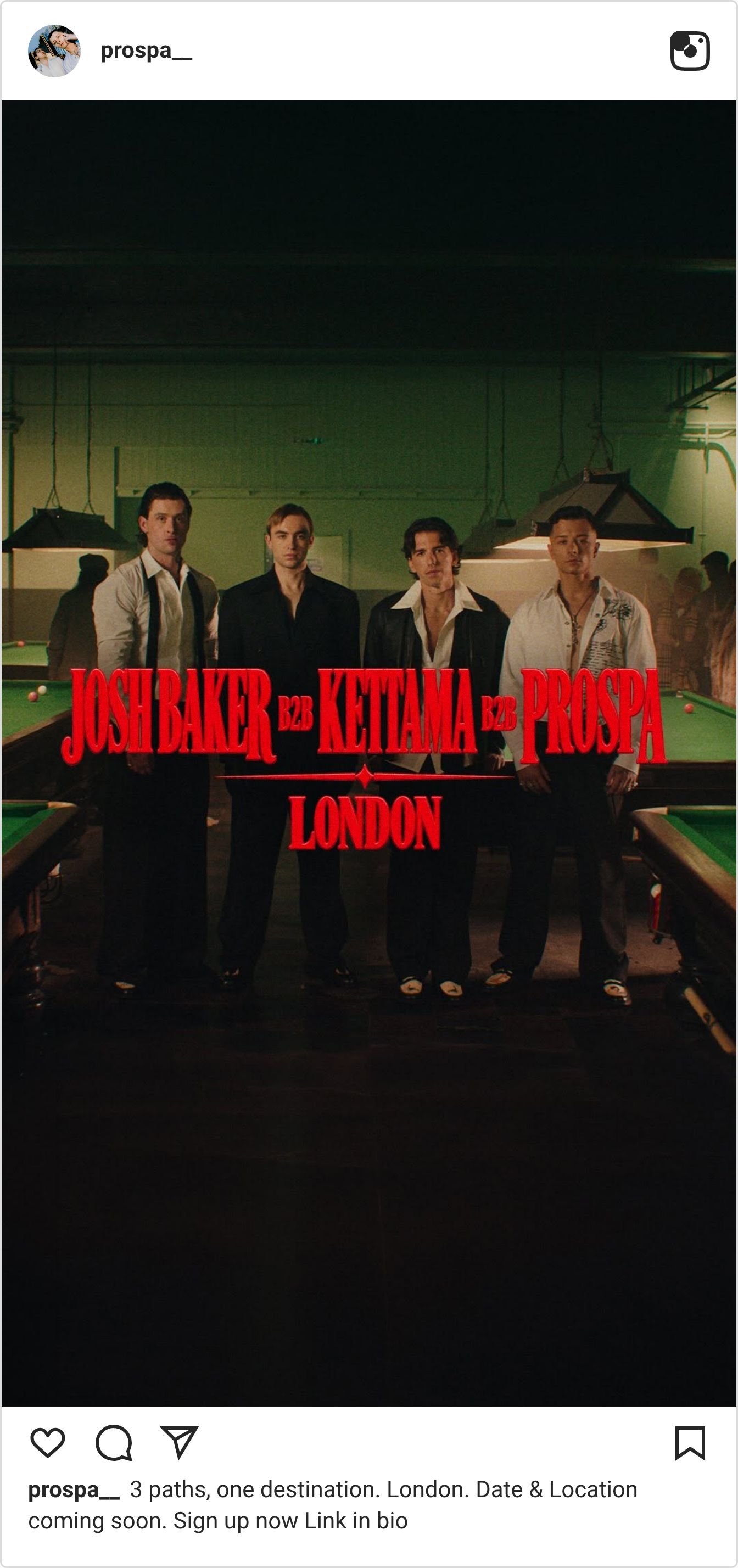
Technically, it’s a B3B involving four DJs, given that Prospa is made up of two members. And while this Avengers-type concept isn’t entirely new – with the acts performing together at Coachella in April – the scale of what they’re now bringing to the UK is something else entirely.
The response has been extraordinary, too. Their first Finsbury Park date sold out within an hour of presale opening, prompting two additional shows which subsequently sold out as well. That’s reportedly 135,000 tickets across one weekend, an achievement that speaks volumes about their individual and collective popularity.
In many ways, it’s incredibly impressive and a testament to how far they’ve all come. But the sheer scale of it does raise some interesting questions, at least for me, about the appeal of these elaborate DJ combos.
Because if you strip away the names, the marketing, and the occasion itself, you’re left with three acts that, while sharing some musical similarities, have developed their own distinct sounds and identities.
Josh Baker’s groove-led house isn’t exactly the same as KETTAMA’s harder, more euphoric style, while Prospa brings another dimension through their blend of house, rave, and melodic influences.
Of course, that doesn’t automatically mean they can’t complement one another. If anything, the contrast might make the performances more interesting. But with four people with different approaches sharing the decks, how much room is there for each artist to express what makes them unique? And does creating a cohesive set inevitably mean someone has to compromise?
It then becomes a question of whether the main attraction is hearing what they can create together, or if there’s an element of simply wanting to say you were there.
This doesn’t just apply to the names mentioned above, as we’re seeing these B2B variants elsewhere, too. I actually attended a B4B at Drumsheds recently, where Max Dean, Luke Dean, Locky, and Mad.Again took to the decks together as part of the NEXUP label. And to be fair, I thought it was great.
For me, part of that came down to how naturally their sounds aligned. They’re all operating within a similar corner of house and tech house, and I can’t imagine their USBs look particularly different from one another’s.
There was also, at least in my eyes, a fairly natural hierarchy between the four. Max and Luke Dean are arguably the bigger draws, with Locky and Mad.Again occupying slightly different positions in the scene. This isn’t a reflection of their individual abilities, but it did make the combination feel fairly straightforward.
The set felt organized, cohesive, and – more importantly – like it made musical sense. It wasn’t four recognisable names just sharing a stage for the sake of it. They’re all long-term mates, and the crowd really responded to it.
But then you look at Kaluki’s Warehouse Project event on December 27, which will see Max and Luke Dean joining EDM veterans Jamie Jones and Joseph Capriati for another B4B.
On paper, it might sound great – four established DJs, each with their own following, coming together for an exclusive performance (again, that Avengers-type concept). But do these artists really complement each other in the same way?
Jones and Capriati have spent a much longer time establishing their own musical identities, while Max and Luke Dean represent a somewhat different generation and sound. There might be some areas of crossover, but bringing all four together sounds like a big challenge more than anything.
And unlike the Drumsheds example, where the musical direction is obvious enough, this seems a lot less straightforward. Who sets the tone? How much does each artist adapt?
Don’t get me wrong, there are plenty of possibilities here, and I genuinely hope it's a great show. But I can’t help looking at this in much the same way as the Josh Baker, KETTAMA, and Prospa announcement. At some point, someone presumably has to compromise elements of their individual style to make the whole thing work.
And that brings us back to the underlying question: does adding more names to a lineup necessarily create a better musical experience, or does the exclusivity of the combination become the attraction itself?
The appeal in many ways is obvious from a commercial standpoint. You’re bringing multiple fanbases together, creating an exclusive billing, and marketing an experience as ‘must-see’ or ‘once-in-a-lifetime’. And I guess there’s nothing inherently wrong with that.
But I do wonder whether we're reaching a point where the spectacle is becoming just as important as the music itself. A B4B featuring four major names generates excitement long before anyone knows what they'll actually sound like together. And the bigger the spectacle, the greater the expectation, particularly when audiences are paying premium prices.
What actually makes a good B2B?
To be clear, I’m not suggesting B2Bs have lost their value, or that major artists shouldn’t be sharing the decks. Quite the opposite, if anything. When they work, they can offer something far more exciting than either DJ playing alone. The question really is what actually makes that happen.
For me, it starts with musical chemistry. That doesn’t necessarily mean that two DJs need to play identical styles or have spent years working together. Often the most interesting partnerships come from artists with different influences who know how to bring them together cohesively. But there needs to be some shared understanding of where the set is going, and a willingness to respond to what the other person is doing (as I observed with the NEXUP B4B).
Of course, the upcoming combinations I’ve questioned could be completely wrong – Josh Baker, KETTAMA, and Prospa could deliver something brilliant, as could the Kaluki B4B. And I’d be happy to say so. My concern is that we’re being sold the significance of the names before we’ve had much reason to believe in the musical connection.
At the grassroots level, that connection is often built in real time. DJs end up sharing the decks with someone they barely know, with little chance to play every transition. They’re forced to listen closely, adapt to unfamiliar records, and sometimes abandon the direction they’d intended to take. That’s a genuine skill to nurture, and part of what makes B2Bs exciting in the first place.
It’s also why some of the best B2Bs I’ve encountered haven’t involved huge names at all. There’s something refreshing about watching two DJs take risks without the weight of a major promotional campaign or thousands of ticket buyers expecting a certain song or moment.
I'd love to see bigger promoters make more room for that spirit. Rather than always pairing one headline act with another, why not give an emerging DJ a chance to share the decks with someone more established? A headliner could bring an artist from their label or local scene onto a major festival stage, giving them exposure while potentially pushing themselves in an unexpected direction.
It might not sell quite as many tickets on the announcement alone. But if the result is a genuinely memorable set, isn't that a better measure of what a B2B should be?
Final thoughts
Ultimately, my concerns around the growing number of B2Bs, B3Bs, and B4Bs come down to how these performances are being booked in the first place.
It feels as though we’re reaching a point where the dance music scene is constantly looking for something bigger and more elaborate to maintain the extraordinary attention and ticket sales we’re seeing. And with growing complaints about festival and event lineups becoming repetitive, bringing the big names to one stage offers promoters a relatively straightforward way to create something that feels new.
But is that really the answer? If we’re pairing DJs primarily to generate excitement around a lineup, rather than because there’s a genuine musical connection between them, I wonder whether we’re losing sight of what makes the format so appealing in the first place.
I also can’t see this trend slowing down anytime soon – if anything, I expect we’ll see even more combinations going into next year. I just hope there’s continued thought going into who’s being paired together, and more importantly, why.
I genuinely hope these huge B3B and B4B shows deliver – but let’s be honest, would it matter if they didn’t? If you’ve already bought a ticket to see several of your favourite DJs sharing a stage, is the quality of collaboration really what attracts you to it in the first place?
Anyway, I don’t want to end this on a negative note, particularly when there are so many brilliant examples of what the format can offer.
I want to spotlight a few incredible B2Bs, including some personal favourites I think are well worth listening to. And since much of what I’ve discussed so far revolves around house music, I’ve made sure to branch out to a few different genres. Hopefully, there’s something here for everyone.
My recommended B2Bs
KI/KI B2B Marlon Hoffstadt (Techno/Trance): These two love going the distance with their sets, and nothing showcases that better than their five-hour session on Zeebrugge Beach in Belgium. Perfect for getting you through a long shift.
Interplanetary Criminal B2B Malugi (Garage): Utter filth, this one! Two notorious shellers feeding off each other's energy and delivering absolute chaos behind the decks. It doesn't get much better.
Jamback B2B Denis Quin (Tech House): One of those pairings that just makes complete sense. And I won't sugarcoat it – this might be my favourite B2B of all time. The set is absolutely ridiculous.
Turno B2B Gino (Heavy Drum & Bass): This one's mental. An hour of relentless energy that's like injecting a double espresso straight into your system. Another pairing that just makes perfect sense.
Enjoy!
